

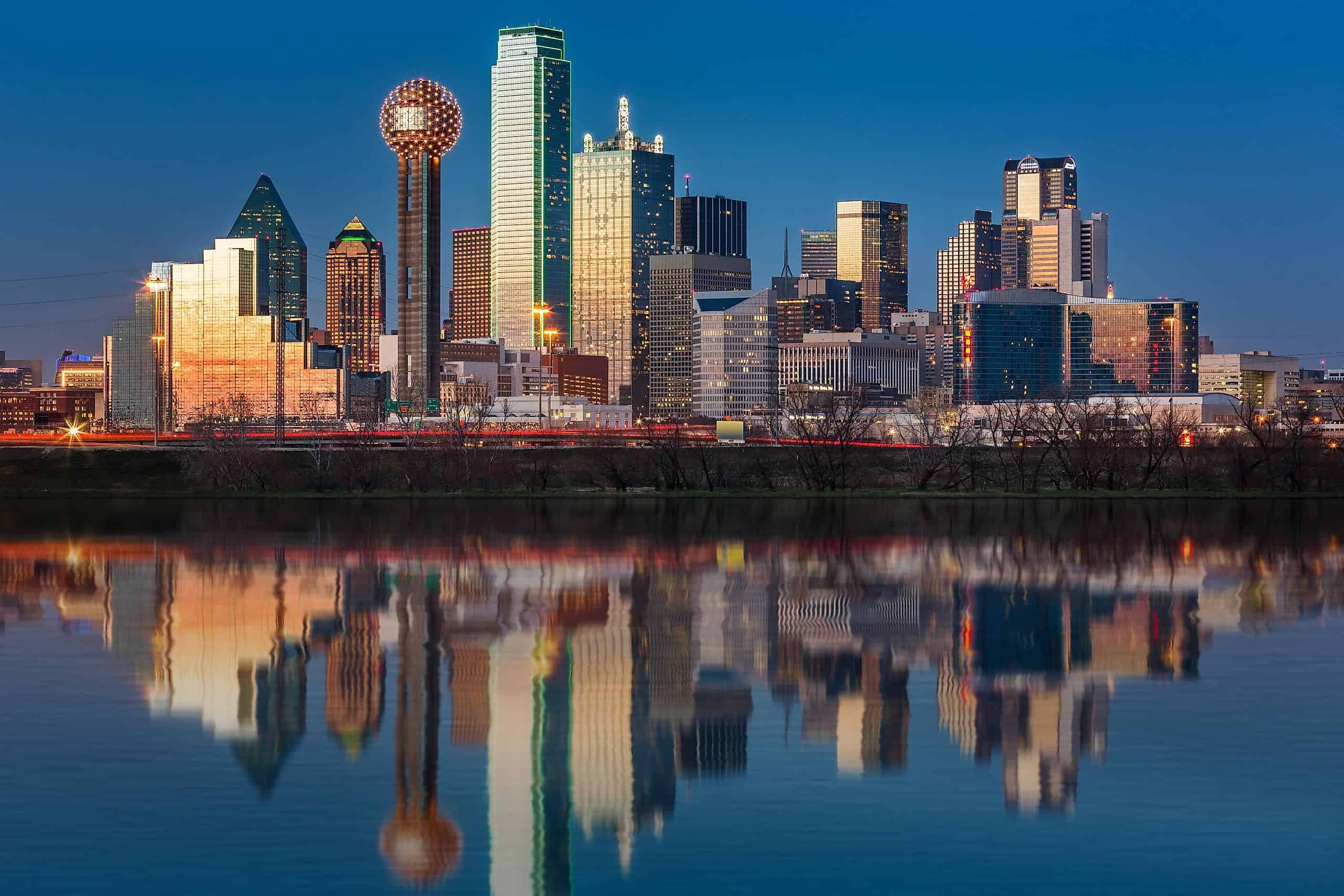
Is Dallas Conservative or Liberal?

If you’re planning a move and typing “is Dallas liberal or conservative” into a search bar, you’re really asking a more personal question: will this place feel like home? Here’s the short, data-backed answer.
The city of Dallas votes solidly Democratic, Dallas County is one of the most Democratic counties in Texas, and the surrounding metroplex is genuinely mixed, with several large suburban counties leaning Republican.
If that surprises you, you’re not alone — Dallas may carry the most outdated political reputation of any big city in America.
Below, we’ll walk through the verified 2024 numbers, untangle the city-versus-county-versus-metro confusion that trips up almost everyone, and explain why the old image persists — so you can figure out where in the area you’d feel most at home.
Is Dallas a Red or Blue City?
By the numbers, Dallas is a blue city — and it isn’t especially close.
In the 2024 presidential election, Dallas County backed Kamala Harris 60% to Donald Trump’s 38%, per the official county canvasses compiled by TexasCounties.net. Out of 254 Texas counties, only Austin’s Travis County (about 69% for Harris) and tiny Presidio County in far West Texas posted higher Democratic shares — making Dallas County the second-most Democratic large urban county in the state. It has voted Democratic in every presidential election since 2008. The pattern holds down-ballot, too: in the 2024 U.S. Senate race, Dallas County went about 63% for Democrat Colin Allred against Republican incumbent Ted Cruz, per county results.
The city proper runs bluer still. Dallas doesn’t publish a single citywide presidential tally — results are counted by county and precinct — but a Dallas Observer analysis of the 2024 precinct maps shows most of the city voting Democratic, with the strongest margins south and east of downtown, fading to lighter blue and eventually red toward the far north.
For national calibration: Los Angeles County went about 65% for Harris in 2024, per its certified results. Dallas County’s 60% puts it far closer to LA than to Texas as a whole, which backed Trump roughly 56% to 42% in the certified statewide count. If you’re weighing that particular cross-country trade, our guide to moving to Dallas from California covers the practical side.
One honest footnote: like most large urban counties nationwide, Dallas shifted toward Trump between 2020 and 2024 — the same Observer analysis found that most city precincts cast more Trump votes than they had four years earlier. The county still delivered a 22-point Democratic margin. Blue, but not monolithic, and trending with the rest of urban America rather than against it.
Is the Whole DFW Metroplex the Same?
No — and this is where most of the confusion about Dallas’s political leaning comes from. “Dallas” can mean three different things, and each votes differently:
- The City of Dallas: about 1.3 million people, and solidly Democratic by precinct results.
- Dallas County: the city plus a ring of inner suburbs — about 2.6 million people, 60% Democratic in 2024.
- The DFW metroplex: a region of roughly 8 million people across a dozen-plus counties, including Fort Worth’s Tarrant County, which leans Republican, and the fast-growing northern counties of Collin and Denton, which have long voted Republican.
Here’s how the layers actually voted in November 2024:
| Area | 2024 presidential result | Lean |
|---|---|---|
| City of Dallas | Most precincts voted Democratic (no single citywide tally is published) | Solidly blue |
| Dallas County | Harris 60%, Trump 38% | Solidly blue |
| Tarrant County (Fort Worth) | Trump 52%, Harris 47% | Leans red |
| Collin County (Plano, Frisco, McKinney) | Trump 54% | Leans red |
| Denton County | Trump 56% | Leans red |
| Texas statewide | Trump 56%, Harris 42% | Red |
Sources: official county canvasses as compiled by TexasCounties.net, FOX 4’s post-election county roundup, and the Dallas Observer’s precinct analysis.
So when someone tells you “Dallas is conservative,” they’re usually describing the metroplex — or the state — rather than the city. The metro really is purple: a Democratic core in Dallas County, a Republican-leaning western anchor in Tarrant County, and northern suburban counties that stayed Republican in 2024 even as they added hundreds of thousands of new residents. In practice, that mix means your job, your gym, and your kids’ soccer league will almost certainly include people from both sides of the aisle, no matter which county you land in.
If you want the street-level version — which neighborhoods and suburbs lean which way, with numbers — see our full breakdown of Dallas neighborhoods and suburbs by political lean.
Is Dallas More Liberal Than Houston?
At the county level, yes — measurably. Dallas County went 60% Democratic in 2024. Harris County, which contains Houston, also voted Democratic, but by a much narrower margin: about five points, per its official tally. Both counties moved toward Trump between 2020 and 2024, but Dallas County remained the bluer of the two by a wide margin.
Comparing the cities themselves is trickier, since neither publishes a city-limits-only count. Precinct maps in both metros show the familiar pattern of bluer cores and redder edges. The county numbers, though, give you the honest headline: both metros are anchored by Democratic-voting counties, and Dallas’s is the bluer of the two.
Politics is only one line on the comparison sheet, of course — cost of living, commutes, and job markets shape daily life far more, and our complete Dallas vs. Houston comparison guide walks through all of it.
Why Do People Think Dallas Is Conservative?
Three reasons — and none of them is current election data.
The image was set decades ago. Dallas’s national political reputation hardened in the early 1960s, when coverage after November 1963 cast the city as a conservative stronghold, and it was reinforced through the 1980s by oil wealth, the primetime TV drama that carried the city’s name, and the Cowboys’ “America’s Team” branding. For a long stretch the votes matched the image: Dallas County backed the Republican nominee in every presidential race from 1992 through 2004. Then it flipped in the mid-2000s and has voted the other way in five straight presidential elections — a nearly two-decade-old shift that the national perception still hasn’t caught up with.
“Dallas” often means “DFW.” The hyphenated shorthand bundles Dallas with Fort Worth, a separate major city more than 30 miles west whose county leans Republican. Blend the two anchors with the northern suburbs and you get a purple average that gets attributed to Dallas itself.
The map plays tricks. Republican-leaning precincts tend to cover far more land; Democratic-leaning ones tend to be dense and compact. A North Texas voting map reads as a blue core fading through purple to red as you move outward — and the red zones dwarf the blue ones in acreage even where the blue ones hold more voters. Glance at the map and “conservative Dallas” looks plausible. Count the votes and it isn’t.
None of this is a value judgment in either direction. It’s simply why “is Dallas liberal or conservative” remains such a common search: the data-backed answer contradicts a 60-year-old image.
What This Means If You're Moving to Dallas
A few practical takeaways, whichever way you lean:
- Coming from a Democratic-voting big city? The city of Dallas will vote more like your old zip code than you might expect — our guide to moving from NYC to Dallas digs into how the day-to-day compares.
- Lean Republican? You’re a short drive from large, established communities that vote the way you do, especially across the northern counties and much of Tarrant — nobody is stranded on a political island in this metro.
- Set policy expectations correctly. City and county voting patterns coexist with statewide law made in Austin, and our guide to moving to Dallas from a blue state covers how that plays out in everyday life.
- Zoom in before you sign a lease. The 2024 precinct maps show pockets just a few miles apart that voted more than 50 points differently, so the sharpest question isn’t “is Dallas red or blue?” — it’s “which part of it fits me?”
- Remember that county lines matter. Your ballot, your local officials, and even your polling place change the moment you cross from Dallas County into Collin, Denton, or Tarrant — worth knowing before you choose between two houses a mile apart.
And whatever the political map says, the moving checklist looks the same in every zip code. For the bigger picture — housing, jobs, weather, costs — start with our guide to moving to Dallas in 2025.
FAQ: Dallas Political Leaning
Is Fort Worth conservative?
Fort Worth anchors Tarrant County, which voted for Trump 52% to 47% in 2024 after narrowly backing Biden in 2020 — one of the biggest counties in America that genuinely swings. Precinct analyses show Fort Worth proper voting closer to even, while suburban Tarrant County votes decisively Republican.
Is Dallas more conservative than Austin?
Somewhat, by county results. Travis County (Austin) was the most Democratic county in Texas in 2024 at about 69% for Harris, while Dallas County came in at 60%. Both sit far to the blue side of the state overall — Austin’s margin is simply larger.
Has Dallas always been a blue city?
No. Dallas County voted Republican in every presidential election from 1992 through 2004, then flipped — it has gone Democratic in all five presidential races since 2008, per county results.
Are there conservative areas in and around Dallas?
Plenty. Collin and Denton counties both voted Republican in 2024; most of Tarrant County outside Fort Worth did the same, and a handful of enclaves inside Dallas County voted reliably Republican as well. Whichever way you lean, there’s a corner of the metroplex where most of your neighbors vote the same way you do.
Moving to Dallas? We Know Every Shade of the Map
Element Moving & Storage moves families into every corner of the metroplex — blue city blocks, red exurban cul-de-sacs, and all the purple in between. Once you’ve picked the part of Dallas that fits, our local moving team will handle the rest, from a high-rise downtown to a two-story in the northern suburbs. Get your free quote today and land in the right place — politics, patio, and all.